Feeds:
Posts
Comments

Archive for the ‘Jesus Christ’ Category

Life is a lot like the weather.  Sometimes it is wonderful like blue skies and pleasant temperatures.  Other times it is rainy, dull, and dreary.  And on occasion a storm or hurricane decides to roll through.  For those in the northern climes we’ll say a blizzard blasts you.  Today I sit on a balcony at Myrtle Beach as tropical storm Ana decides to come ashore.  As storms go Ana is relatively mild.  Still the wind gusts and at times driving rain are scuttling the plans of many as we hunker down inside and plan to “make the best of it.”

Today several of our friends are going through hurricanes in their lives.  A precious 2 year old succumbed to cancer yesterday.  Another friend lost her only brother who leaves behind a wife and two young daughters.  Other friends are dealing with struggling relationships – marriages being attacked and threatened.  These painful events are akin to the wind, rain, and battering waves that threaten to destroy beach, buildings, and any soul who mistakenly wanders out into the storm.

Jesus talked about exactly these sorts of situations and He used a weather metaphor to do so.  In Matthew 7:24-27 Jesus describes the wise and foolish builders.

Therefore everyone who hears these words of mine and puts them into practice is like a wise man who built his house on the rock. 25The rain came down, the streams rose, and the winds blew and beat against that house; yet it did not fall, because it had its foundation on the rock. 26But everyone who hears these words of mine and does not put them into practice is like a foolish man who built his house on sand. 27The rain came down, the streams rose, and the winds blew and beat against that house, and it fell with a great crash.”

I am an engineer so I know that there are many steps in building a good, solid house.  Jesus really emphasizes only one point in this story – the foundation.  You can do everything else in home construction perfect, but if you have a poor foundation the home will not stand when the earth shakes or the severe storm hits.  Jesus and His teachings are the only truly solid foundation for life.

 Just a little bit later in Matthew we see a real life example of Jesus’ authority demonstrated.  Crossing the Sea of Galilee Jesus falls into an exhausted sleep in the boat when a squall breaks out.  From Matthew 8: 23 – 27:
23Then he got into the boat and his disciples followed him. 24Suddenly a furious storm came up on the lake, so that the waves swept over the boat. But Jesus was sleeping. 25The disciples went and woke him, saying, “Lord, save us! We’re going to drown!”

26He replied, “You of little faith, why are you so afraid?” Then he got up and rebuked the winds and the waves, and it was completely calm.
27The men were amazed and asked, “What kind of man is this? Even the winds and the waves obey him!”
For some storms in our lives Jesus will step in and calm the storm… the layoff passes us by, the diagnosis is marvelously / miraculously wrong, the wayward child comes to their senses and returns home.  For many storms though the Lord, in His infinite wisdom, chooses to walk with us through the storm rather than still the storm.  The promise of scripture and the experience of followers everywhere is that if the Lord doesn’t calm the storm, you can be certain He is with you in the storm.  That is my story.  Jesus’ peace, comfort, and grace have sustained and carried me through every storm I’ve experienced.  And on the other side I am a better person with a stronger faith because of it.  I have been in a particular storm for the past year plus, but I see the end of this storm on the horizon and I am excited.
As I’ve written the bands of wind and rain have continued to sweep through and yet I feel joy in my heart as if it where a beautiful, spring morning.  I know Him who is the foundation of life and He is my strength and shield.  I don’t know where you are in your life, but there is a truth our pastor says fairly frequently.  “Whoever you are you can be certain one of three things is true.  Either you are in a storm, you’ve recently come through a storm, or there is a storm in your future.”  This would be pretty discouraging IF we didn’t have a sovereign God who knew how to bring good out of every storm and Who walks with us through them.
If Jesus and His words are your life foundation, then join me in praising Him in the rain.  If you do not yet know Him, please comment to my blog and I will be happy to reach out and introduce you to the Lover of your soul who wants to be your foundation.  Ask the Lord to help you know Him.  Also pick up the bible and start reading.  The gospels are the best choice, but I would be happy to correspond with you and give you some suggestions based upon your life situation.
Be blessed today and be a blessing whether you are in the sunshine or in the rain.

Read Full Post »

Over the past few weeks I have taken more time to study one of the chief “villains” in the Easter story, Caiaphas, the high priest who orchestrated Jesus’ crucifixion.  While I have contemplated the Easter story hundreds of times through the years, I have always just lumped Caiaphas and his father-in-law Annas into the group of evil religious leaders who conspired to have Jesus killed by the Romans.  While true, I realize this superficial look misses a vital lesson that we need to consider in our walk with the Lord.

  • How did these men who were steeped in the religion of the Jews miss the coming of the Messiah?
  • As the prophecies were fulfilled why did they not stop, reconsider, and acknowledge that Jesus was who He claimed to be?
  • Finally when Jesus rose from the dead, why did they not get the message then?

Answers to these questions will help us find the right path that they failed to see.  Simply stated “Wrong Motives Made Them Miss the Messiah

For these men, religion defined by their interpretation of the Law, meaned everything.  Most importantly it trumped the relationship aspect that God desires to have with His children.  King David was called a man after God’s own heart because He was passionate to know the Lord.  You can’t help but see this intimacy in many of David’s psalms – see Psalm 51, 91, 139 for good examples of this intimacy.  For Caiaphas the protection of the “purity” of the Law was His responsibility.  As high priest he was the final arbiter in disputes and interpretation of how it was applied.  Viewing his role as the primary custodian of the Law, Caiaphas took exception to any view of the religion different from his.  When asked by one of the religious leaders what the greatest commandment was Jesus response was not about religion but relationships.  From Matt 22:35-40:

One of them, an expert in the law, tested him with this question: 36“Teacher, which is the greatest commandment in the Law?” 37 Jesus replied: “ ‘Love the Lord your God with all your heart and with all your soul and with all your mind.’ 22:37 (Deut. 6:5) 38 This is the first and greatest commandment. 39 And the second is like it: ‘Love your neighbor as yourself.’ 22:39 (Lev. 19:18) 40 All the Law and the Prophets hang on these two commandments.”

Jesus’ message of a relationship with God and particularly His boiling the Law down to two keys struck the religious leaders as a direct attack on everything they stood for.  They saw their religion threatened and their defenses were on the alert to any further subversion of their religious practice.  Their religion made it hard for them to see the living God among them.

There was also the potential political threat of Jesus teaching.  Jesus was amazingly popular.  He brought a message to every man, woman, and child of a God Who loved them deeply, Who care for them intimately, and through signs and miracles wrought by Jesus’ hand, was actively engaged in people’s lives.  Under the Roman occupation though popular figures were considered a threat who could marshal the masses to rebel and this was not acceptable.  Both the Romans and the Religious leaders were determined to prevent a rebellion, therefore Jesus walked under a cloud of suspicion.  On a number of occasions Jesus pointedly rejected the political route even though many in the crowd clamored for Jesus to fulfill the popular interpretation of the conquering, kingly Messiah.  But both the Romans and the Religious leadership heard the crowds, they saw them growing, and they felt the threat to the delicate balance in this hotbed of sedition.  Their political view made it hard for them to see the living God among them.

Annas’ was of the Zadokite clan.  The high priesthood had resided in the Zadokite clan for hundreds of years.  When Alexander the Great conquered and rose to power he transferred power away from the Zadokite clan.  The Romans however restored power to Annas’ ancestors building a political and financial relationship that was mutually beneficial to both parties… at the expense of the general population.  Taxes, fees, exchange rates, and monopolies on religious essentials allowed the priestly families to become incredibly wealthy.  They in turn shared some of this wealth with the Roman’s in the form of tribute.  To the religious leaders Jesus assault upon the money-changers and vendors selling animals in the Temple was more than just an attack on their prescribed religious practices, it was an attack on their carefully crafted and extravagant livelihood.  Their lifestyle and the financial pipeline from the religious practices that poured lots of money into their pockets made it hard for them to see the living God among them.

Finally as the story of Easter plays out the religious leaders’ anger, hatred, and rage finds its full vent upon Jesus.  That Jesus does nothing to resist them, nor does He do anything to try and deflect their accusations causes the mock trial, torture, and execution to progress rapidly.  In approximately 24 hours Jesus goes from kind and gentle leader of a small band of disciples to a dead body in a grave.  The book “Killing Jesus” by Bill O’Reilly and Martin Duggard brings to light much of the context and backstory that we may not pick up just from reading the biblical text.  The high priest and religious leaders broke numerous religious laws in the way they handled Jesus’ case, however they justified it all on religious and political expediency.  On the third day, when the tomb is opened and the body of Jesus disappears despite a Roman guard stationed at the tomb, I would think that they might have second thoughts about who Jesus was and the validity of their actions.  Instead they make up a story about the body being stolen and attempt to carry on life as normal.  Their pride and their guilt made it hard for them to see the risen God among them.

We’ve looked at roadblocks to recognizing and accepting the Lord for Who He is.  It is also true that these same obstacles will keep us from growing in our faith.  Jesus has called us to live an abundant life.  But it is important to realize that this abundant life begins and ends in our relationship with Him.  Every one of the areas mentioned above: our religious observations, our political leaning, our lifestyle and financial provision, even our emotions are to subservient to our knowing and growing in Christ.  The message of Easter is that Jesus is Alive.  Let us live fully in the reality that Jesus is Alive and wants to live in us more fully every day.  Say “YES!” to Jesus’ continuing work in you and you will experience His love in greater and greater measure day by day.

Be blessed my friend and be God’s blessing right where He puts you today.

Read Full Post »

John, the beloved disciple, concludes his gospel with an interesting sentence.  John 21:25 says “Jesus did many other things as well. If every one of them were written down, I suppose that even the whole world would not have room for the books that would be written.”  While many of us have a few noteworthy accomplishments and amusing anecdotes from our life, Jesus’ life is the life above all lives to be studied.  Although He lived for a relatively brief period, He is the central figure of history.  The book that describes His life is the all time best-seller.  It is printed in more languages than any other book.  And despite repeated attempts to blot out His story and crush His people, the church continues to grow.  As believers in Jesus we have a responsibility to become followers of Him.  In Matthew 7:21 Jesus said, Not everyone who says to me, ‘Lord, Lord,’ will enter the kingdom of heaven, but only the one who does the will of my Father who is in heaven.”  How do we do this?  In reality this is a simple, impossible task.  We simply read the book that tells us about Jesus and God’s work in the believers, the bible, and then we do what it says.  It is impossible for us to do this perfectly in our own strength.  That is why Jesus to sent the Holy Spirit to all who would follow Him.

As a young believer I heard someone explain the difference between being intelligence and wisdom.  Intelligence is the ability to grasp and understand large amounts of information.  Wisdom is the ability to apply the information one possesses in the right manner.  I witness this in my work with plant managers and leaders in manufacturing.  The truly special leader is one who possesses a good intelligence and exercises excellent wisdom.  Many are the leaders who are intelligent, but do not walk in the most wise fashion.  In Matthew 10 Jesus gave directions to His disciples as they were being sent out on a brief training mission.  In verse 16 we read  “I am sending you out like sheep among wolves. Therefore be as shrewd as snakes and as innocent as doves.”  Jesus does not want us ignorant of His work.  He admonishes us to become as knowledgeable as practically possible, yet walk in humble innocence. 

Our church is a good example of what God can do through a group of committed believers who seek to follow Jesus every way we can.  We are a bunch of imperfect people seeking to know and serve a perfect God.  One of our Pastor’s tag lines is a simple phrase, “Read the Word.  Do what it says.”  By doing that we see people come to faith by the dozens and even hundreds.  We do not have a final count, but as of 9 am on Sunday morning we had already seen over 200 people come to faith in Jesus.  And at the 9:15 service at our campus I saw dozens more come forward and make a profession of faith.  This is a wonderful thing to see.

This is the first vital step into the abundant life Jesus calls His followers into.  Being the first step carries the certainty that there are many steps to follow, too many and too varied to be addressed in a short post.  However the Holy Spirit, who seals every believer at conversion, is able to lead and guide each believer into the life God calls them to.  The Holy Spirit knows what is needed, what is not, where we must go, what we must do.  In short, the Holy Spirit is God living in us to guide us into all that we need to know and do.  The caveat here is that the Holy Spirit is still subject to the will of the believer.  Jesus desires to work in concert with us.  Our willful obedience, not our coerced obedience, is God’s desire.

Today, I encourage you to do a few things that may be new.  First, ask the Lord to instill a fresh desire in you to know Him better.  Second, ask the Lord to show you anything inside of you that is hindering your taking your next step in faith.  Third, read the Word and ask the Lord to help you do what it says.  Fourth, listen and respond to the leading of the Holy Spirit.  He will always lead you in accordance with the Word of God.  In fact the bible and the Holy Spirit are always perfectly in synch.

The Holy Spirit inspired the writers of the bible to put down the words we read.  It is the Holy Spirit indwelling the believer who gives us the ability to read, understand, and follow what it says.  If you feel lead to do something that is contrary to the bible, then stop and seek the Lord’s clarification.  I have had the Lord prompt me to do things that I thought were odd, things that definitely took me out of my comfort zone, things that I normally wouldn’t have thought to do, but I have never had the Holy Spirit prompt me to do something that is against the scripture.  Let this be a safeguard for you.

In the post-resurrection days, the Church literally exploded into life.  People recognized that God had done the most amazing thing the world would ever know.  It remains the pivotal point in all of history.  And people were moved to live in a radically new way, following the teaching of the One who had conquered death and called them to this new life.  We have the opportunity to follow in their footsteps.  Jesus calls us to Himself and then into the unique life He has equipped us for.  Immerse yourself into learning about and following the One who loved you so much He went to the cross on your behalf.

Be blessed today my friend.  And be a Spirit led blessing to others.


Read Full Post »

The world was forever changed on Easter morning.  On Friday sin was judged and the just penalty was paid in full.  On Sunday the Lord rose triumphantly from the grave proving He had not only paid the penalty, but He defeated death, hell, and the grave in the process.  ALLELUIA, JESUS IS RISEN!  THE LORD IS RISEN INDEED!

In Friday’s post I shared pics from the Church of the Holy Sepulcher over the most likely site of Golgotha and the empty tomb.  Just outside the current city walls there is another potential site where there was a rocky face that had the appearance of a skull and an empty tomb in a garden.  During our trip to Jerusalem last spring we visited this site.  Whether this site is the actual burial place or not, it much better depicts what it would have looked like.  I share these pics with you today in hopes that this Easter you experience God’s grace in a new and powerful way.  He died for you and He rose for you.  Lift up you heart, your hands, your voice to Him this day… and be thankful!

IMG_0625

DSCN0439

Picture from around 1900 of what the rock face looked like.  This was also beside a major road out of Jerusalem which was another necessary characteristic of the Roman's.  Crucify in a very public place to send a message to other would be rebels.

Picture from around 1900 of what the rock face looked like. This was also beside a major road out of Jerusalem which was another necessary characteristic of the Roman’s. Crucify in a very public place to send a message to other would be rebels.

Communion shared in the Garden Tomb.  Jesus said, "Do this in remembrance of Me."

Communion shared in the Garden Tomb. Jesus said, “Do this in remembrance of Me.”

IMG_0674

IMG_0670

DSCN0450

IMG_0681

IMG_0680

IMG_0682

IMG_0683


Read Full Post »

Between the delivery of the promise and its realization is the “Tween Time”.  On Good Friday Jesus died.  Through the Holy Sabbath that followed the disciples, His followers, the religious leaders, even the Roman authorities lived in the ‘tween time.  Consider what each group must have experienced through this day of waiting.

His disciples were crushed.  They had lost their leader, their friend, the One they had left their lives and livelihood to follow.  They had thought He was going to become the leader who would set them and their nation free from Roman oppression.  They were Jesus’ closest friends and confidants.  Simply losing someone dear is a terrible shock.  But they had thought Jesus was so much more.  Now He was gone.

They were also very afraid.  It was bad enough that the religious leaders had it out for Jesus, but the Romans had actually carried out the execution.  And one thing about Roman justice when it came to even a hint of rebellion, they were not afraid to squash it ruthlessly.  If they had crucified Jesus because they felt He was a threat to Roman rule, then His disciples would soon follow.  Recent uprisings had seen not only the leader crucified, but dozens and sometimes hundreds of their followers crucified as well.

In varying amounts they were also ashamed.  They fled when Jesus was taken.  They were not able to stand this simple test.  Peter personified this sense of guilt for the group.  He promised to stand with Jesus going to the garden, but within just a few hours he had denied knowing Jesus even with an oath.

His other followers were bewildered.  They too had put their hopes in Jesus.  Many had experienced healing at His touch.  Others had been set free from demonic bondage.  Thousands had seen and experienced His miracles whether in the food that multiplied when He prayed or through sermons that touched the heart.  They knew these things that had happened were real… or at least they thought they were real.  How could it be that the One who demonstrated such power had so quickly been taken from them?

The religious leaders were a mixture of smug assurance that a very real threat had been eliminated and still a little wary since the impostor had spoken a number of time about “life after death”.  While they felt confident that Jesus’ death would put an end to this growing challenge to their power, they took steps to ensure no further complications could arise by the Galilean’s followers taking His body and saying He had arise.  They convinced Pilate to have the tomb carefully guarded.

The Roman authorities were probably not too terribly worried about the whole issue.  Pilate, for His part, was not particularly pleased that he had to stoop to being the pawn of the religious leaders in this incident, but his tenuous hold over this restive Roman province was predicated upon a good “working” relationship with the Jewish leaders.  As requested, a Roman guard posted at the tomb of this man, Jesus, was a simple final task in this unsavory business.  Soon the Passover would be over and he could return to Caesarea away from these religious fanatics.

On this Saturday everyone was convinced a climax had been reached, the curtain had drawn closed, and Jesus’ life and mission had been completed.  Jesus’ powerful presence had been the engine that was driving the movement and now He was gone.  While no one really knew what to expect a couple things were certain.  The religious leaders had stopped this movement by cutting off the head and the disheartened, frightened band of disciples and followers were certainly in no condition to keep it going.  This Jesus movement was a thing whose time had passed.

At least that is what they thought on Saturday in the ‘tween time…

Read Full Post »

Good Friday is a time to remember what Jesus did for us.  He was innocent.  But He chose to die in obedience to the Father and out of love for us… for you and for me.  Consider what He did.  For the story from 4 perspectives Read Matthew 26:57 – 27:61, Mark 14:43 – 15:47, Luke 22:47 – 23:56, John 18:1 – 19:42.

He was innocent.  He never sinned.  At a time of great political tension in the land Jesus did not antagonize the foreign power that ruled.  In fact His message and heart reached out to the Romans who listened and were receptive to truth.  Remember the Roman centurion who asked for prayer for his servant.  Jesus’ only “issue” was that He stood up to the religious authorities and He called them out about their hypocrisy.

He was powerful.  He did not have to die.  He certainly did not have to die the brutal way He did… if He chose not to.  When He is arrested in the Garden of Gethsemane, His followers begin to mount a resistance, but Jesus tells them to stop and that He could overwhelm His accusers with 12 legions of angels.  But He chose to obey the Father’s plan and submit to them instead.

He was gentle.  When Jesus faced His death, He laid aside any and every attempt to soften the path.  I woke up at 3 this morning and I immediately thought about Jesus.  At that time He was probably with the Sanhedrin.  He had already been beaten, spit upon, and cursed by many.  He was nearing 24 hours being awake.  Don’t forget the intense sorrow He had experienced in the garden, sorrow and anxiety so intense that He had sweated blood.   Already He had to be close to physical and emotional collapse.  Yet He stood and He took their worst.

He was beaten and battered.  In addition to the beatings He took from the religious leaders and the temple guards, Jesus was brutalized by the Romans who were professionals at administering pain and death in the most horrific fashion.  Seriously, the Romans knew how to inflict the utmost pain and humiliation upon a person.  It was a key ingredient in how they kept such a large empire under control.  Make the penalty for resistance and rebellion so unbelievably cruel and painful that almost no one will stand against you.  These were Jesus’ executioners.  The most realistic portrayal of this is in the movie – The Passion of Christ.  It has been a part of my spiritual discipline to watch the movie on Good Friday primarily because it portrays what Jesus went through… for you and for me.

He was loved and He was being separated from the ones He loved.  The images of His mother, His disciples, His close followers mingled in the crowd of “haters” as He was led to Calvary had to pain Him further.  But even more excruciating had to be the separation from His heavenly Father for a time.  In fact this is probably the biggest deal of all.  Jesus, the One Who existed in union with the Father from before the world began, was about to experience something that happened only this once in all eternity.  As judgment passed on Jesus for all mankind’s sin, His Father turned away.  When the sin was judged, Jesus knew separation from the Source of all life, His heavenly Father.  Matthew captured this moment in Matt 27:45 – 46.  Jesus cried out, “My God, My God, why have You forsaken Me?”  We know why today.  The Father’s love desired to make a way for us to be reconciled to Himself.  The demands of justice had to be met.  Through the death of the only sinless, perfect soul, our redemption was purchased.

Again I encourage you to take the time today to let the weight of what Jesus did rest upon your soul for a little while.  When we understand how much He did for us… how low He was willing to go to reach us… what great a price He paid for us, we cannot help but be deepened in our love and devotion to Him.  That God loves you so much that He experienced Good Friday is amazing beyond description.

Receive the Lord’s blessing today in rich abundance.  And share His blessing with those He brings into your life.

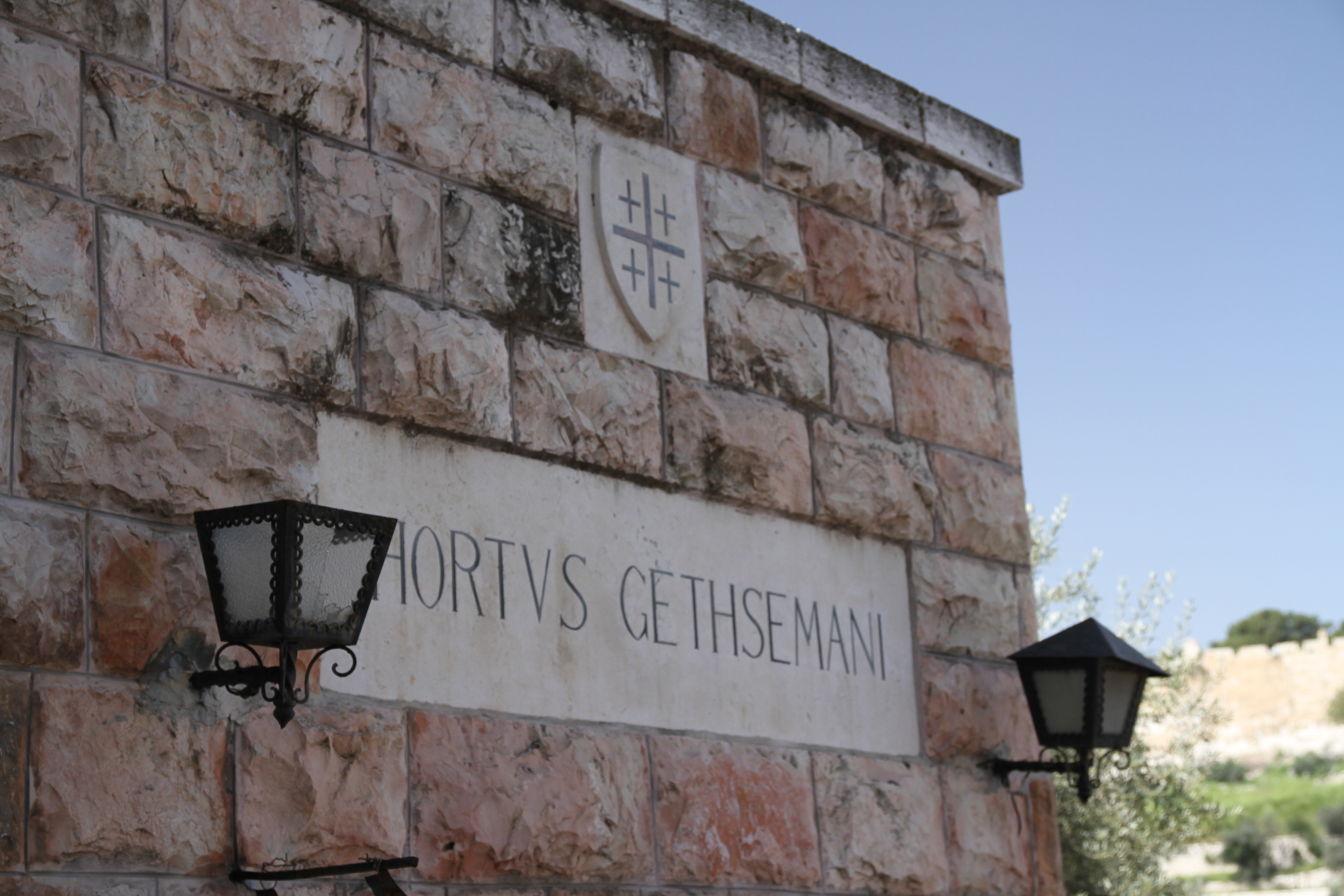
Here are pictures from our trip to Jerusalem.  Actually we walked the Via Delarosa exactly one year ago today.  I begin with pictures of the Garden of Gethsemane.

Garden of Gethsemene

Garden of Gethsemane

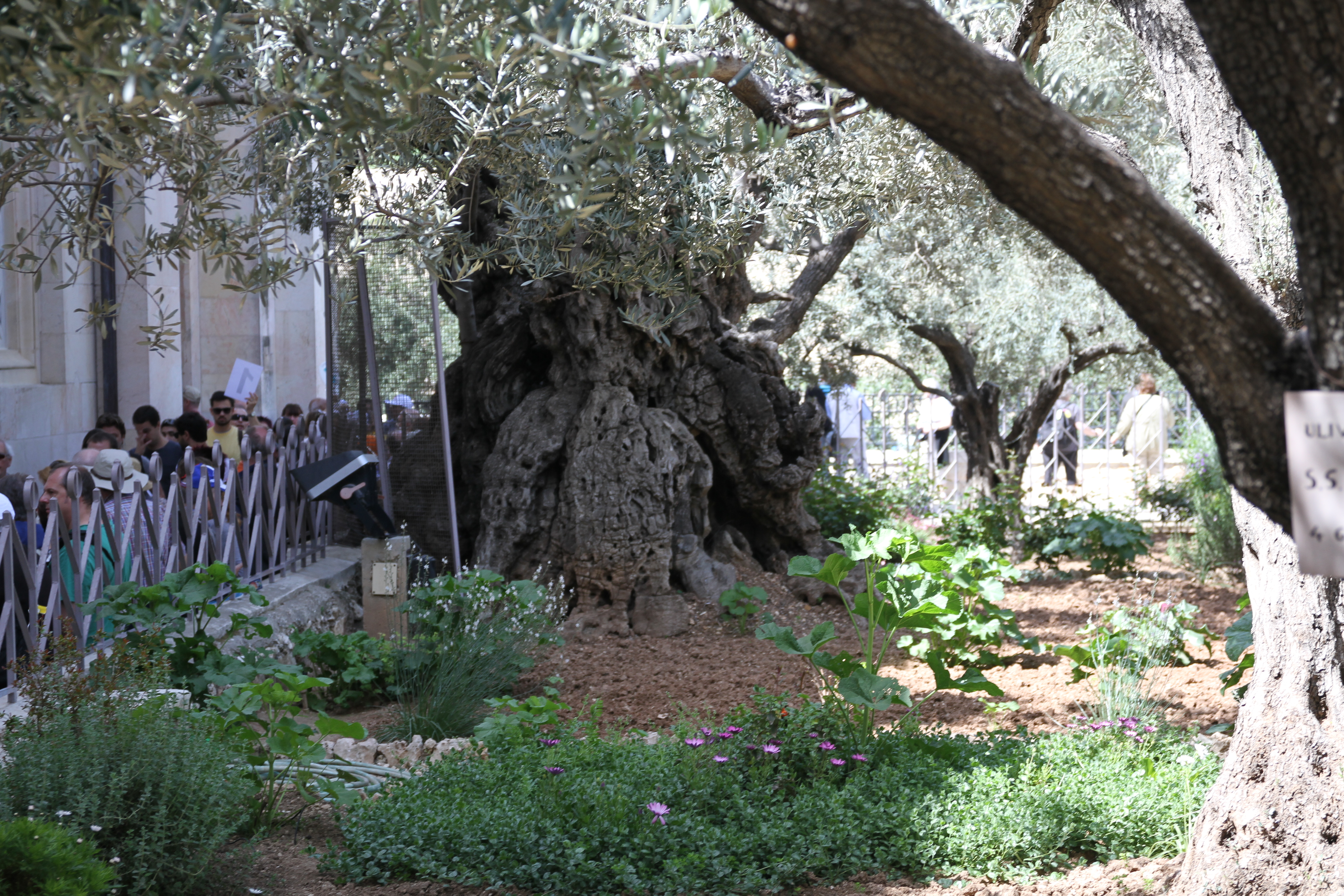
Ancient Olive Tree in the Garden.  This tree is hundreds of years old.

Ancient Olive Tree in the Garden. This tree is hundreds of years old.

Inside the Church of All Nations in the Garden.

Inside the Church of All Nations in the Garden.

The altar in the Church of All Nations is directly over a large rock outcropping that was in the Garden.  This is a likely place where Jesus prayed.

The altar in the Church of All Nations is directly over a large rock outcropping that was in the Garden. This is a likely place where Jesus prayed.

The Garden of Gethsemene was the location of an Olive Press.

The Garden of Gethsemane was the location of an Olive Press.

Our guide indicated that while these trees are possibly over a thousand years old, they roots continue to send up shoots and they live for thousands of years.

Our guide indicated that while these trees are possibly over a thousand years old, the roots continue to send up shoots and they live for thousands of years.  So these roots existed at the time Jesus was arrested here.

Front of the Church of All Nations.

Front of the Church of All Nations.

Next is the area where the Roman fortress Antonia was located.  Here the final part of Jesus’ mock trial was completed, where the Roman scourging took place, Where He was dressed in a purple robe and a crown of thorns and mocked, where he was disrobed, and where His march to Golgotha began.

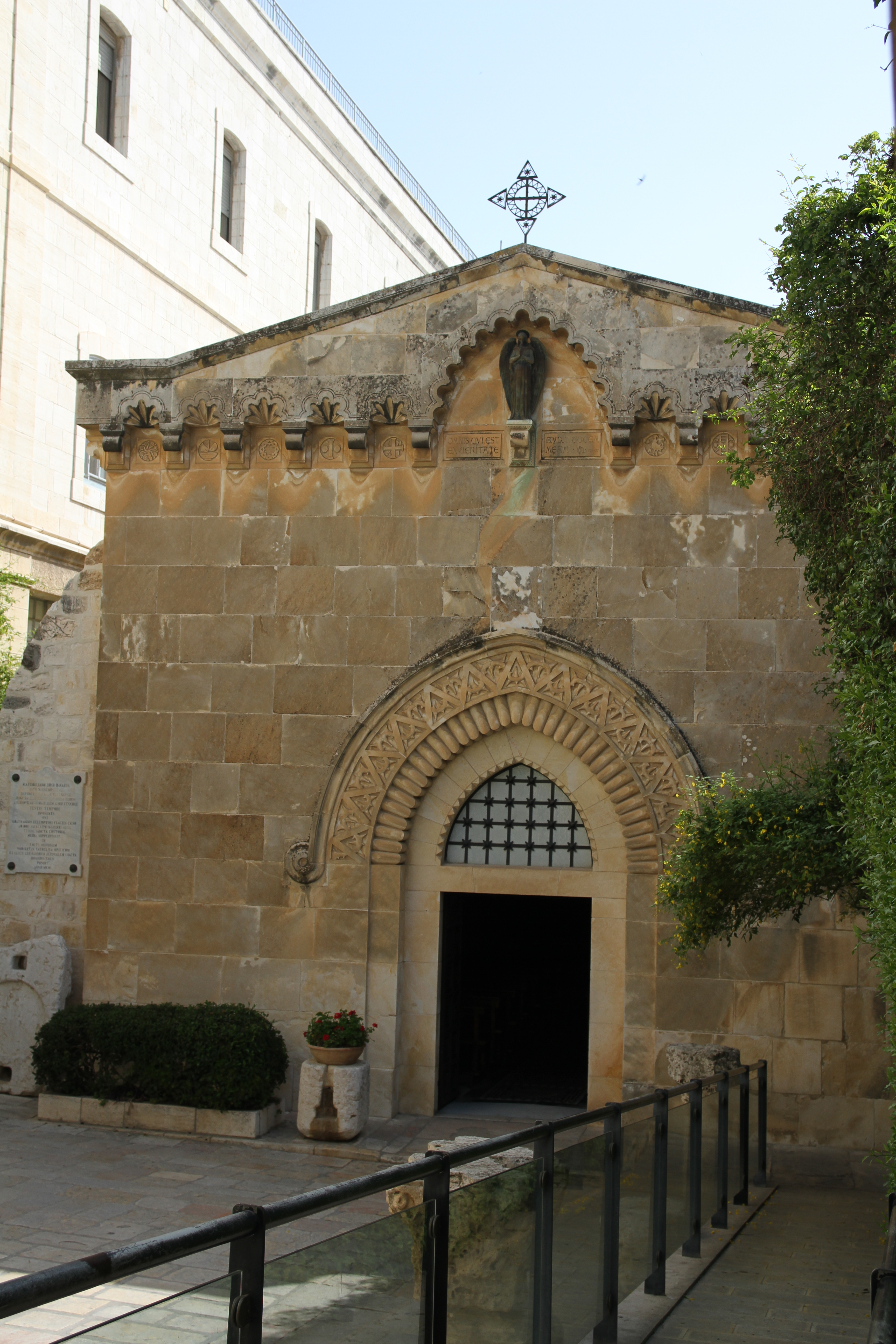
This is the Church of Condemnation.  The area surrounding the "Stone Pavement" mentioned in John 16:19.

This is the Church of Condemnation. The area surrounding the “Stone Pavement” mentioned in John 16:19.

Inside the Church of Condemnation.

Inside the Church of Condemnation.

In the Church of Condemnation

In the Church of Condemnation

This is the Stone Pavement where Pilate tried to release Jesus.  He brought Jesus out wearing a crown of thorns and wearing a purple robe.  But the crowd, incited by religious leaders, shouted, "Crucify Him! Crucify Him!"

This is the Stone Pavement where Pilate tried to release Jesus. He brought Jesus out wearing a crown of thorns and wearing a purple robe. But the crowd, incited by religious leaders, shouted, “Crucify Him! Crucify Him!”

Details on the Stations of the Cross.

Details on the Stations of the Cross.

IMG_9543 IMG_9544

Inside the Church of Flagellation.

Inside the Church of Flagellation.

IMG_9548 IMG_9549 IMG_9550 IMG_9551

Standing at the beginning of the Stations of the Cross

Standing at the beginning of the Stations of the Cross

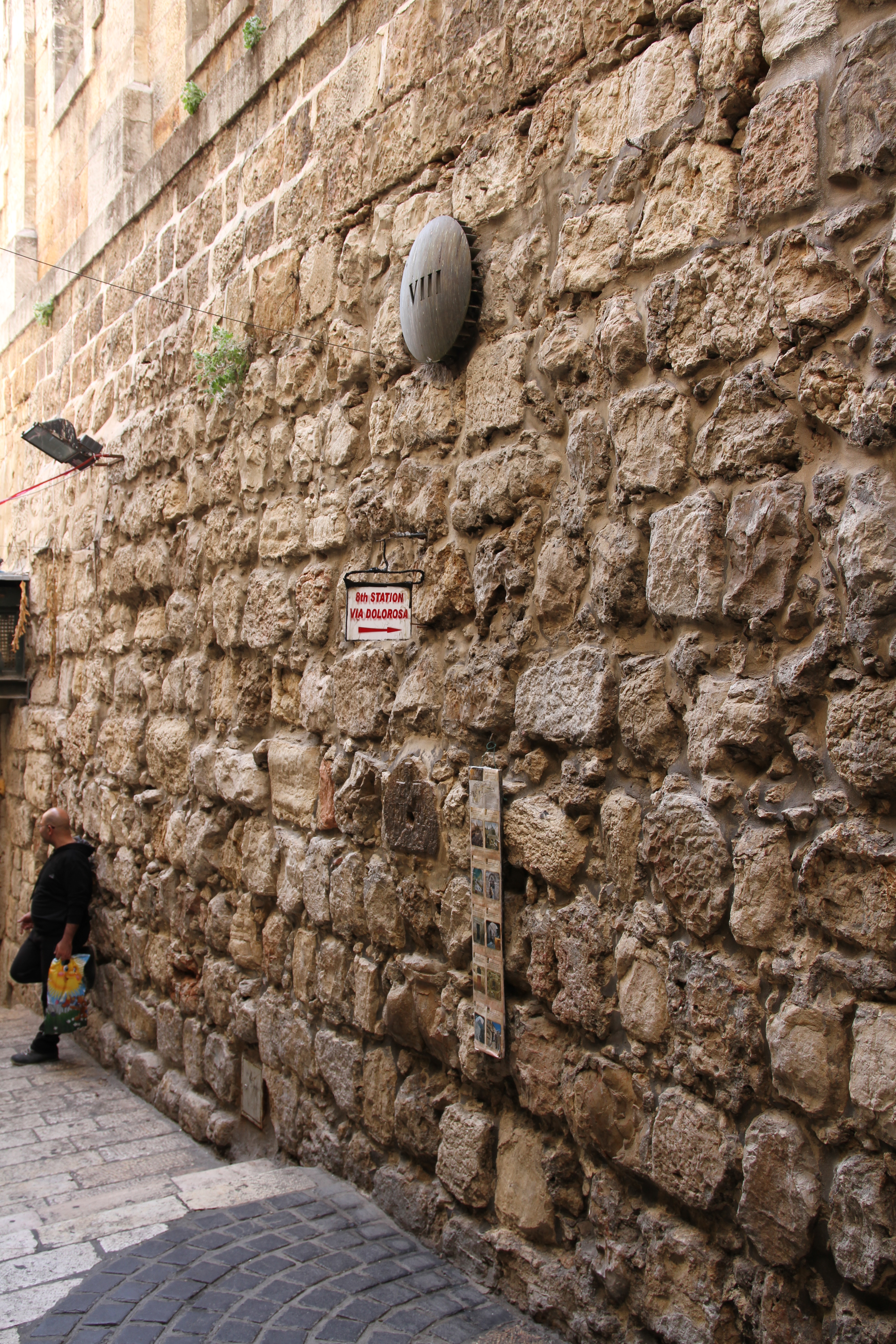
The following shots are several of the Stations of the Cross as we wind our way through the streets of the Old City of Jerusalem.

IMG_9554 IMG_9555 IMG_9556 IMG_9558 IMG_9559 IMG_9561 IMG_9562 IMG_9563 IMG_9567

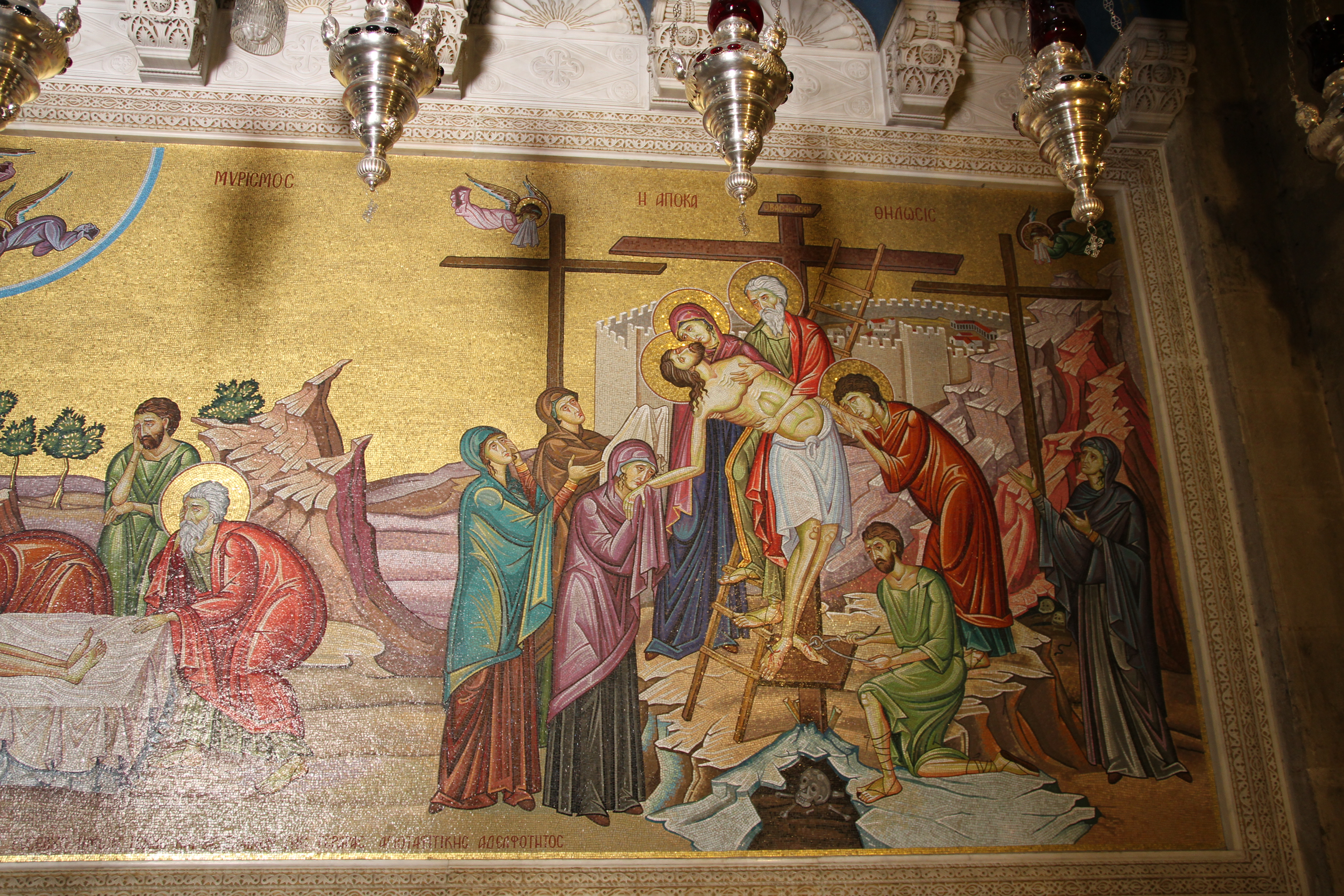
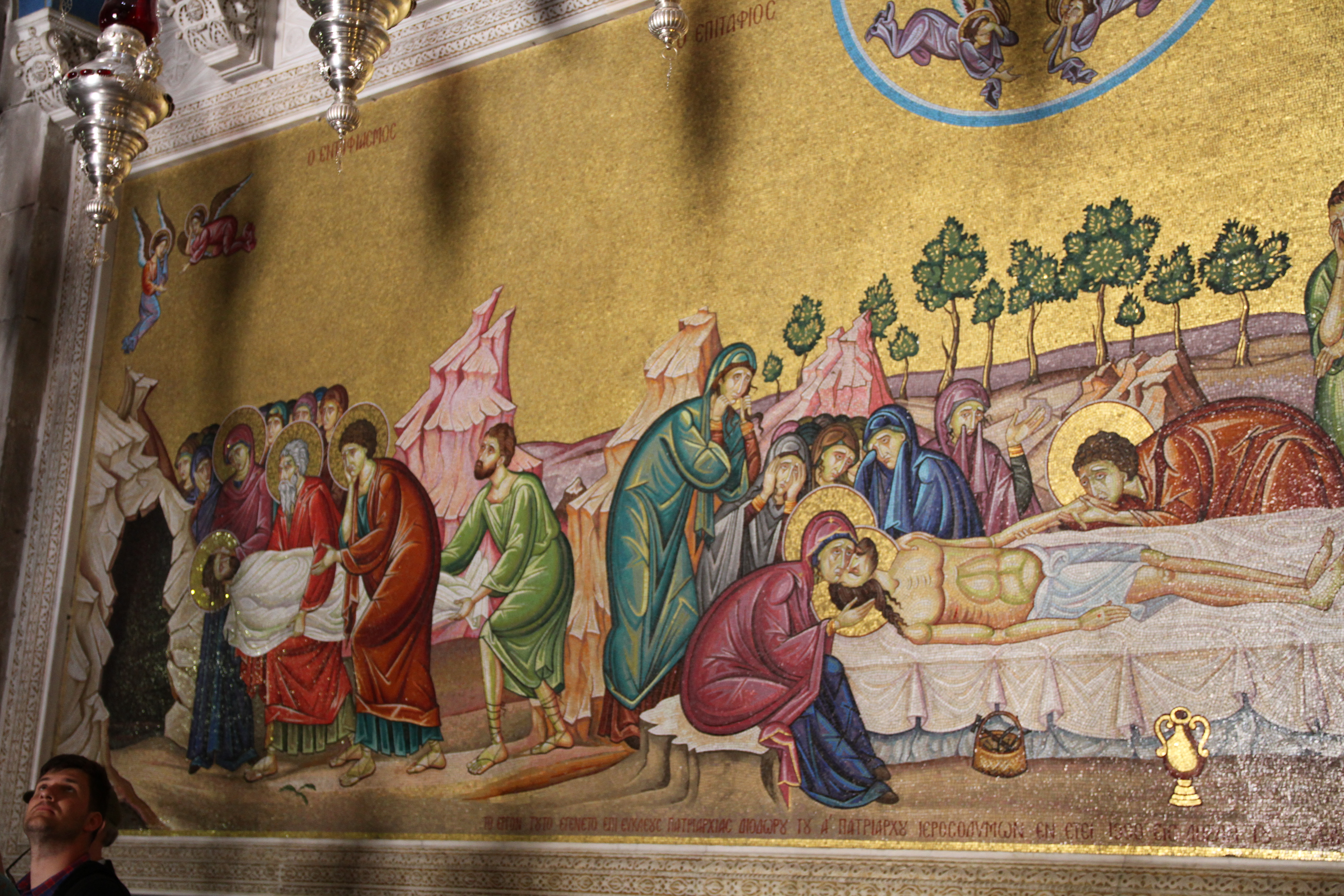
These final pics are from the Church of the Holy Sepulchre which is over the most likely site of Golgotha (also referred to as Calvary) and the Garden tomb.  This church was built in 326 AD.  It is also called the Church of the Resurrection in the Orthodox Church.

IMG_9577

IMG_9585

This altar is over the rock that is believed to be Golgotha, the “place of the skull” where Jesus’ cross was erected. Here a pilgrim leans in to kiss the rock.

IMG_9598

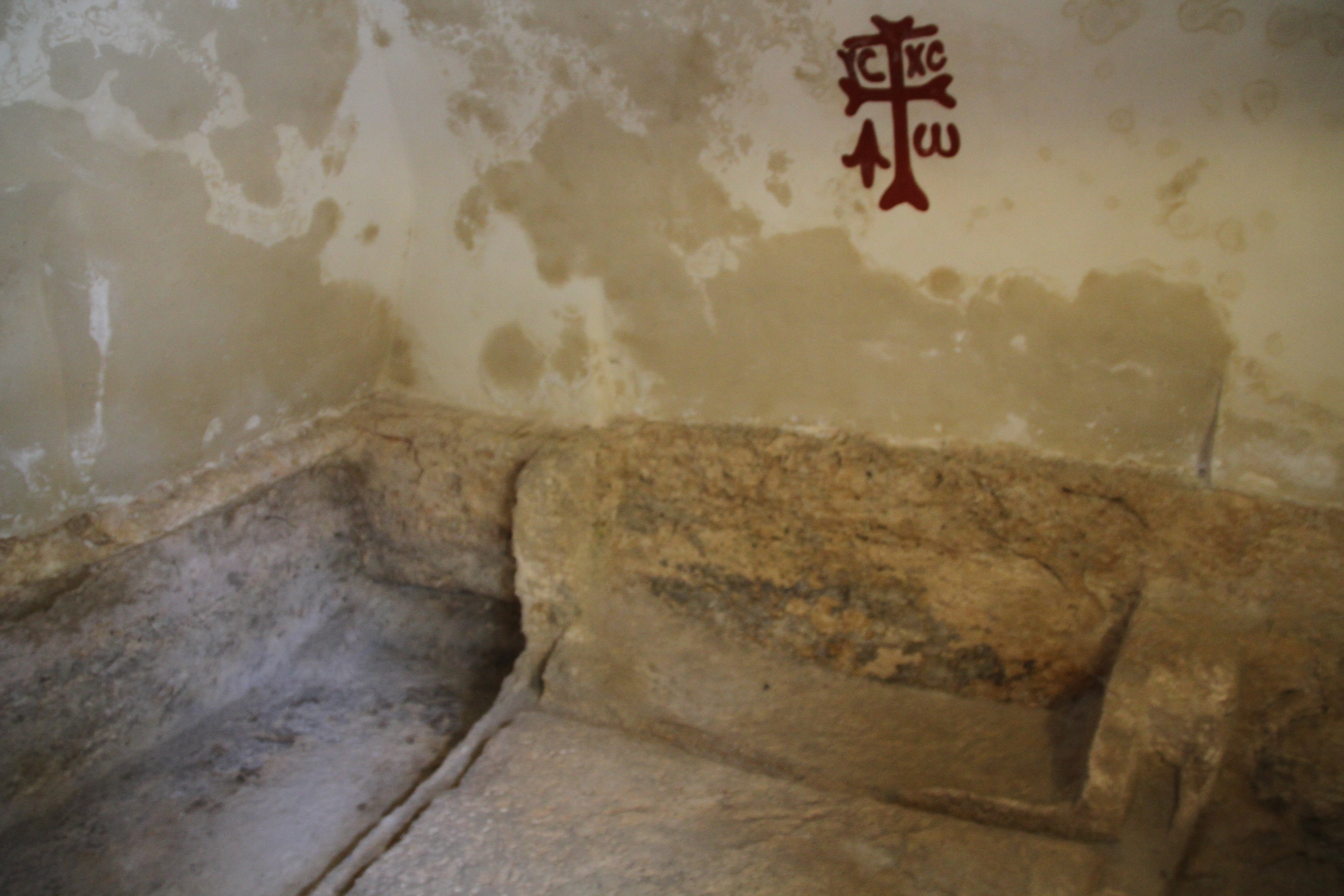
This slab is supposed to represent where Jesus body was laid in preparation for burial.

IMG_9579IMG_9581IMG_9580IMG_9594IMG_9592

Read Full Post »

Good Morning this Maundy Thursday of Holy Week 2015.  For much of the night I pondered and prayed about what to share this morning.  Holy Week is climactic in the life of a believer as we relive Jesus final earthly hours and culmination of why He came.  As I alluded to yesterday Jesus came with a primary purpose and a number of secondary purposes.  Some of His secondary purposes were to give us an example of how to live, to touch lives in His day that were later recorded so we would know how to minister, and to send the Holy Spirit to live within us who would further our living and ministering in faith.  His primary purpose was to give Himself up as a perfect sinless sacrifice for sin so that through Him everyone would have a path to forgiveness and restoration with God the Father.  I heard on the news this week that a recent study found that over 50% of youth and young adults do not know the reason for the Easter season.  That is sad.

I am praying for a groundswell of truth seeking for I am convinced that if people seek truth, they will find God.  This is never more accurate than if they simply look into the facts about Jesus.  I have spoken with unbelievers and invariably their response has fallen along a couple of distinct lines.  Either they don’t want to be bothered by seriously considering the claims of Christ or they simply have never taken the time to weigh the evidence and apply logic to determine what is true.  In my experience the root of unbelief for those who have heard the gospel and not accepted it has always been a sin they were not willing to give up or look past long enough to consider is Jesus who He said He is.

One of the things I have done a lot in my career as an engineer is Root Cause Analysis.  The most effective way to get to the real reasons a failure occurs is to diligently gather all the evidence, make sure it is valid and accurate, and then put those pieces of evidence together to see what story it tells.  I have been involved in hundreds of these investigations and if this process is followed, we always resolve the issue.  However I have seen a number of situations where the investigator approached a failure with a preconceived idea of what the root cause was and the investigation did not go well.  You see, if we approach a question with a bias ahead of time, it becomes much more difficult to accept the evidence at face value.  We look for evidence that supports our hypothesis.  In many cases unconsciously.  In others it is conscious and willful.  We will overlook or dismiss evidence that does not fit our hypothesis.  Additionally when we have a bias from the outset, we are not able to effectively apply logic.  Remember that one of the key principles of logic is that when all the evidence is weighed, if all other options are eliminated, then the remaining option, regardless of how unlikely, must be true.  (I think I heard the character Sherlock Holmes say that recently.)

The ultimate question then becomes “Who was Jesus?”  People who haven’t investigated all the facts and applied logic will often respond, “Oh Jesus was a good man.”  “He was a wise and good teacher.”  Or perhaps they will even go so far and say what Islam says about Him, “He was a great prophet.”  However those are not valid choices as the ultimate declaration of who Jesus was.  To make the claims He made and to suffer an indescribably cruel and painful death as He did, there are really only three choices.  One he was insane and delusional in the most extreme sense.  Two He was the greatest deceiver who has ever lived.  Or three, He was who He claimed to be.  Jesus claimed to be God’s Son – to be One with the Father.  He claimed to be able to forgive sins.  In John 14:6 we read “Jesus answered, ‘I am the way and the truth and the life.  No one come to the Father except through me.'”  These are extremely bold claims.  A good man does not make Himself equal to God unless that is Who He truly is.  Otherwise He is either a deceiver or mad.

The evidence is pretty substantial.

  • We have eye witness evidence from multiple sources of the life and miracles of Jesus.  They are amazing stories.  And if we do not allow our biases, either for or against to sway us, then we put those into the “validation bin” to determine a little later if we admit them as true and valid.
  • We have the number of prophesies in the ancient Hebrew sacred texts (the Old testament of the bible) written 400 – 1000 years before Jesus’ birth that fit what we know about His life perfectly.  Many of these were fulfilled completely independent of any thought or action He could have taken.  Here are a few of the 100+ prophesies fulfilled in the life of Jesus.
    • Virgin birth
    • Born in Bethlehem
    • Herod’s killing of all male babies in Bethlehem (except Jesus who had escaped to Egypt) after Jesus birth
    • From the lineage of David
    • The manner of His death
    • The advent of John the Baptist
    • Plus many more to numerous to capture here.
  • The fearful disciples who hid themselves after the crucifixion were transformed into life long evangelists after His resurrection.  Eleven of the twelve were martyred with John the only one to suffer a natural death albeit in exile because of His faith.
  • Jesus’ body was never found.  This is really huge. Remember the key principle about logic mentioned above.
    • If the disciples had stolen the body (highly unlikely) one of them would surely have broken and confessed when under the threat of death.  And while it is possible a person might die to cover up a lie, that such a large group of people maintained the same story speaks to the truth of the tale.
    • If the authorities had taken the body all they had to do was show the body and the movement would have been stopped at the outset.
  • The number of post resurrection appearances Jesus made.  All told Jesus appeared to over 500 people after He was ressurected.  And because of this they were transformed into faithful followers even through persecution and death.
  • The accuracy and validity of the bible.  This is actually evidence to support the validation process.
    • The bible is far and away the most studied book of antiquity.
    • There are more high quality ancient manuscripts of the bible than any other book from antiquity by far.  Some of these manuscripts are from within just a few decades of the original documentation.  A recent ceremonial mask from Egypt was found and carefully studied.  I believe the date was from around 80 AD.  The mask was made from papyrus that had short selections of the Gospel of Mark in it that authenticated current texts.
    • The dead sea scrolls found in the Judean desert in 1947 had a large number of Hebrew texts that proved the accuracy of current texts.
    • Along these lines, an understanding of the absolute rigor and holy reverence with which the Jewish scribes approached the copy of the texts ensures the highest level of accuracy and attention to detail.
    • The secondary sources such as the writings of the Jewish historian Josephus that support the historical details surrounding Jesus and the time and place He lived.
    • Even the manner of the biblical writings supports its authenticity.  A consistent message and story is presented with enough variability to show it was compiled by different persons with slightly different perspectives.  The minor differences do not in any way take away from the central tenants of the faith, but they do reveal an integrity in documentation and copying.  This supports the argument that what we have today is in the same form as the original writers, some eyewitnesses and some recorders of eyewitness accounts, intended.
  • The growth of the church from the humblest of beginnings, ie. one man crucified upon a Roman cross after only a three year itinerant ministry in a very small, remote, and isolated province of Rome, to the 2 billion Christians in the world today.
  • Lastly, the lives of people throughout history and continuing today, who are changed because of knowing the risen Lord.  Jesus is alive today and He is still meeting people and transforming them through His mercy and grace.

I am one of those people Jesus has changed.  I have met the Lord.  He has saved me.  He has brought much positive change in me.  I would love to say I am totally faithful and complete in every way, but I am not…yet.  I, like all faithful believers, am a work in progress.  But I am growing because He is real and He is walking with me, helping me to become more and more like Him.

Dear friend, I hope this has encouraged you today.  If you are a believer my desire is that this provide a reinforcement of your faith and help you share that faith with others.  If you are not yet a follower of Jesus Christ I invite you to dig deeper and see if what I have written is true and accurate.  Ultimately I was convinced by the life that I saw in people who claimed to know Jesus and lived with a vibrant, tangible faith.  The rest of the information just solidified my faith once I accepted and started following Him.  Since this is Easter, I encourage you to go to a bible believing church this Sunday and ask the Lord to speak to you.  See if He won’t speak a message of love to you heart.  What do you have to lose?

Be blessed today and be a blessing.

Oh, one more thing.  Three year ago I wrote a blog that is really cool family story called Quest for Truth.  If you want to read about a practical application of Truth Seeking.


Read Full Post »

It is Wednesday of Holy Week in Jerusalem the year 30 AD.  Jesus has less than 48 hours before He is nailed to the wooden beams of a Roman cross.

I often try to put myself in the place of others to see from their perspective.  I have found this an excellent approach at building empathy.  I wonder what Jesus’ mindset was on this Wednesday.  He knew what was before Him.  He had mentioned it to His disciples on numerous occasions (even though it appears they didn’t grasp the immediacy of his prophetic words).  Yet we see in the scripture that Jesus continued His routine.  He resided outside the city, probably in Bethany (Matt 21:17).  His early morning would be spent in communion with the Father.  One of the things I didn’t realize until lately was that Jesus didn’t need to carry a written scroll of the sacred texts.  He had these memorized.  This was actually common among religious Jews, so it is a safe assumption that Jesus knew them by heart.  Of course He knew them – He helped write them.  John 1 tells us that Jesus is the “Word of God” so He knew the scriptures more intimately than any religious person ever could.  He actually understood what each line and phrase was intended to convey.  And that was another reason that He and the religious leaders so often clashed.

After breaking fast with His disciples He would head to back into Jerusalem probably over the road from the Mount of Olives.  Let’s take a minute and consider what breakfast would look like.  Jesus, fresh from His time with His Father in prayer and having been awake for some time already, would be fresh and alive.  I can visualize various members of His band coming in and picking up a piece bread and fruit the women have spread on the table and playful conversations picking up.

“Andrew, did you sleep in the barn again?  You have straw sticking out of your hair.” John asks Andrew as he sleepily walks into the large room.

“Speak for yourself John.  From your smell I would say you slept in the barn AND you haven’t bathed in a month,” Andrew replies.

“Andrew, he is just a boy.”  James exclaims.  “He hasn’t learned that a man must bath at least once a week if he is to share close quarters with his friends.  Out in the fields and walking in the wilderness he can get away with only the occasional ritual bath, but not when we all come to Jerusalem.”

“He will get His ritual bath soon enough,” Jesus says.  “We all will be cleansed very soon.  Passover is upon us my brothers.  A very special Passover indeed.”

After breaking fast they would take the 30 minute or so walk to Jerusalem entering through one of the massive gates in the city wall.  They would proceed to the Temple.  One of Jesus’ favorite places to teach was Solomon’s colonnade.  Here he would take a seat and begin to teach.

These final few days were a political chess match.  Jesus continued to teach and heal while the religious leaders repeatedly tried to trap Him in His words.  One day they asked Him about paying taxes expecting Him to either anger the authorities by saying NO or displeasing the crowds by saying YES.  Instead Jesus says, “Render unto Caesar that which is Caesar’s, and unto God, that which is God’s”.   Another time they demand to know by whose authority He is teaching.  They did not sanction Him therefore that are suspect of His credentials.  Not to mention He takes issue with a significant number of their interpretations of the law.  Jesus answers their question with a question.  “I will answer you if you answer my question first.  John’s baptism – where did it come from?  Was it from heaven or of human origin?”  Now they are trapped because they did not accept John’s baptism and message, but they know the people did.  To answer as they truly believe would risk a riot and further alienation from the people.  But to answer otherwise would reveal their blatant hypocrisy.  So they say, “We don’t know.”

If He was stressed by the continued manipulations of the temple leaders, none of the Gospels bear this out.  And personally, I don’t expect that these things surprised or stressed Jesus.  Not because of the fact of His divinity, but because of His intimacy and trust in the Father.  The impression I take from studying Jesus in the scriptures is One who is 100% confident in Himself because of His absolute connection with the Lord of the Universe.  There is no sin to disrupt that connection.  He consistently seeks to know the Father’s will and communes with Him constantly.  And He is obedient to the uttermost.

A logical question arises – did Jesus know all the events each day held beforehand?  We see that a number of times He is aware of what is going to happen… sending the disciples ahead for the donkey on Palm Sunday, waiting for Lazarus to die before heading to Bethany to raise Him, seeing Nathaniel under the tree before they meet.  But I don’t think this has to be extrapolated that He knows every detail of every day.  In fact, I think He knew the details that He needed to know to be in the right place at the right time.  And I am sure that He was given the words He needed at the time they were needed (see Mark 13:11).  This came from His communion with and total faith in the Father which was reflected in complete obedience.  But in keeping with one of the “secondary” reasons He came and lived among us, for Him to effectively model a life we are to strive for, He would have to “walk by faith and not by sight” some of the time.

I encourage you to take time to put yourself in Jesus’ place on this Wednesday in His final week.  Consider what might be going through His mind.  How did He find the will to move resolutely toward His death rather than look for the way to escape.  Then apply that to where you are right now.  What incremental step can you take to grow your faith and move a little closer to the person the Lord has called you to be… the Lord has equipped you to be… the Lord died for you to be.  Don’t misunderstand.  The Lord isn’t calling a person of little to no faith to immediately become one who boldly faces down the religious leaders and willingly dies for Christ.  But He is calling us to grow in our faith today to be a little stronger today than yesterday.  And then tomorrow to grow a little stronger than we were today.  In time, perhaps less than we can imagine, the Lord will put us in places were our natural response would have been to run and hide, but our faith response becomes to stand and proclaim the goodness and richness of the Lord.

Be blessed today my friend and allow the Lord to make you a blessing to those He puts in your path this day.


Read Full Post »

My personal preference is majestic nature views like the vistas in Yosemite Valley or the view from Clingman’s Dome observatory.  However the morning view of Jerusalem from the Mount of Olives is impressive indeed.  Such was the view locals and pilgrims experienced as they crested the Mount and viewed the city over the Kidron Valley.

View of Jerusalem from the top of the Mount of Olives.  The golden dome is the Muslim Dome of the Rock which sits essentially on the site Jewish Temple Mount.  Going even further back into antiquity this is also Mount Moriah where Abraham was directed with his son Isaac.  At the last minute before Abraham sacrificed Isaac, God stayed his hand and provided a ram for the sacrifice.  See Genesis 22.

View of Jerusalem from the top of the Mount of Olives. The golden dome is the Muslim Dome of the Rock which sits essentially on the site Jewish Temple Mount. Going even further back into antiquity this is also Mount Moriah where Abraham was directed with his son Isaac. At the last minute before Abraham sacrificed Isaac, God stayed his hand and provided a ram for the sacrifice. See Genesis 22.

Zoomed-in view of the southern side of Jerusalem.  Shot 1 of 4 with each panning a little further to the north.

Zoomed-in view of the southern side of Jerusalem. Shot 1 of 4 with each panning a little further to the north.

Jerusalem, Shot 2 of 4.

Jerusalem, Shot 2 of 4.

Jerusalem, shot 3 of 4.

Jerusalem, shot 3 of 4.

Jerusalem, shot 4 of 4.

Jerusalem, shot 4 of 4.

It was along the path leading down from this point and into the city that Jesus was hailed by the crowd, probably numbering in the few hundreds.  Recorded in the gospels (Matt 21:1-11, Mark 11:1-11, Luke 19:28-44, John 12:12-19) they shouted, “Blessed is the king who comes in the name of the Lord.” “Hosanna in the highest.”  “Peace in heaven and glory in the highest!”  “Hosanna to the Son of David.”  “Hosanna!”  “Blessed is He who comes in the name of the Lord”  “Blessed is the coming kingdom of our father David.”

It is important to realize that Jesus was still an enigma to many.  Some saw in Jesus the political leader who would rise up and challenge the oppressive Roman regime and lead Israel to freedom.  Others saw a man who made outrageous claims of intimacy with God that bordered on blasphemy.  Many were devoted followers who believed Him to be a great prophet.  And some had even confessed Him as the Messiah, the Anointed One sent from God.  So within the crowd that lined the path and pushed around Him there was religious fervor, political fervor, and a few skeptics who watched, listened, and took notes to report to the religious leaders.

One telling scene during the descent which probably took an hour or more, was that Jesus wept over the city (Luke 19:41).  He knew the opportunity that the people of Jerusalem had, but He also knew that many would miss it.  In the midst of what should be pure celebration, Jesus is saddened by loss those who do not recognize Him will experience.  Unfortunately that is still true for many today.  God is present and alive in the world today, but many still miss Him.  They fail to recognize the time of the Lord’s visitation and their loss is an eternal loss.

That Jesus arrives in an understated manner is part of God’s approach to us.  This approach leaves room for faith.  While some religions believe it is acceptable to coerce conversions, that is not God’s way.  He values the relationship built upon faith.  When we exercise faith in giving up our lives to Him, then the gift He gives is an assurance that He is Who He says He is.

As I think back to my life before I gave my life to Him, I was a fairly religious person.  I think it is important to clarify, I could not see hypocrisy in my life because frankly, I don’t remember my church speaking too strongly against many of the sins I walked in.  I believed in God.  I believed Jesus was His Son.  I attended church almost every Sunday, said confession, and partook of the sacraments.  I tried to be a good guy and follow what the church taught.  What I did not do was regularly read the bible, pray, or live according to all that the bible said about believers.  OK, that sounds like a hypocrite, but from my point of view I was just trying to be like many of the other “Christians” I knew.   I guess I was just like a lot of people in the crowd on that first Palm Sunday waving palm branches and shouting, but not really knowing who Jesus really was.

That changed for me when I finally surrendered and asked Him to be Lord of all my life.  My belief about God and Jesus moved from belief to certain knowledge.  Doing “church” things out of duty morphed into living a life in intimate relationship with the living Lord.  And the Word of God became the source of my inspiration, information, and strength.

Admittedly there have been times when I have struggled to release something, but the Lord has graciously led me successfully through a number of those challenges.  I am sure there are still other opportunities to grow by either giving up something that I don’t really need or adding something the Lord wants me to undertake.  However I am confident that since He has been faithful to lead and help me through those before, He will continue to do so in the future.  Even though He was God’s Son, Jesus prayed and had to lean on God’s strength to pass through some of the tests that He undertook on our behalf.  This is a model for us to follow.

A thunderstorm rolled through early this morning as I was praying about what to write today.  At one point a brilliant flash of lightning streaked across the still black sky just as I looked up.  Jesus had the power to ask, nay command, the forces of nature to obey Him and they would have.  He even said at one point that He had to but ask and legions of angels would respond to His call.  But He did not seek to be spared by any of the means He had at His disposal.  Instead He obeyed the Father perfectly.  He took my place and He took your place on the cross.  He bore my sin and He bore your sin.  The penalty that we were under, He paid.

On Palm Sunday Jesus again set His face resolutely toward Jerusalem.  With raucous celebration around Him he crested the hill at the Mount of Olives and saw the city of His death, burial, and resurrection.  And while He wept, it was not for Himself, but for the city and those in it who would miss what He was doing.  Lord, help us to see, understand, appreciate, and act upon what you are doing in our lives and the lives of those around us – today and every day.  To You be all glory, honor, and praise today and forevermore. Amen!

Be blessed my friend and be God’s blessing to someone today.

Read Full Post »

In 2014 we were fortunate to travel to Israel with a group from our church.  I enjoy learning about history and I am an avid student of geography.  Visiting the places where Jesus lived, walked, and taught was a dream come true.  And while I have studied the bible for over 30 years, being there made it come alive in a new and vibrant way.  This was just before the Arab uprising which stopped travel for several days.  As we progress through Holy Week for the next several days I will share pictures and stories from that trip.  To set the stage for Holy Week I will concentrate upon the trip prior to our Jerusalem visit today.

The three days prior to Jerusalem were spent in Galilee.  We visited Capharnaum, where Jesus was based through His time of ministry, as well as many traditional sites such as the Mount of Beatitudes, the Sea of Galilee, the Jordan River, the Church of the Primacy of Peter where Jesus commissioned Peter to “Feed My sheep”.  An over-riding impression of Galilee was peaceful.  It was easy to picture Jesus walking through this land, ministering to people, healing, delivering, and teaching.  Galilee is fairly rural.  In Galilee the land is dotted with small villages surrounded by lots of fields and open spaces.  It is different from the US where rural often means a single farm surrounded by it’s fields.  I don’t remember seeing any homes remote from others.

When visiting places of historic consequence, I like to imagine what it was like at that time in history.  That means you often have to look past a lot of what has been added as well as seeing through the revisionist history.  Fortunately in the Holy Land you have two major benefits.  First, there is much about the land that has not changed dramatically.  Being such a highly contested area, there has been much ebb and flow to who is in charge, but not a tremendous amount of development that has significantly changed the land.  One of the most significant changes is that modern horticultural techniques have made the land bloom and grow more prolifically than ever, however this has not resulted in significant development and growth… at least not in Galilee.  Along the Mediterranean Coastline, yes, but not so much in Galilee.  The second reason it is perhaps easier to get the feel of what it was like 2000 years ago is that we have the most accurate living document from antiquity to consult when we read the bible.  The bible is far and away the most widely published and read document in history.  And unlike all other ancient documents, the bible can be compared to extant manuscripts from the first century showing the accuracy of what we read today.

One small detail.  I will refer to the Sea of Galilee by its traditional name from the scripture of Sea of Galilee.  However it is technically a fresh water lake.  Water flows in particularly from the snow melt and springs of Mount Hermon and it flows out by way of the Jordan River.


CAPHARNAUM

Matthew 4:13 tells us that Jesus moved to Capharnaum.  It was in this area that Jesus called Simon Peter, his brother Andrew, James, and his brother John.  (Matthew 4:18-22).  It was in this area that Jesus got into a fishing boat and taught the people as they lined the shore.  From this shoreline Jesus would climb into a boat with His disciples and travel to different places around the lake to teach, to heal, and to get away for quiet time with the Father.

Jesus' home during His ministry years.

Jesus’ home during His ministry years.

Ruins in Capharnaum.

Ruins in Capharnaum.

One of the stories set in Capharnaum is found in Matthew 8:5-13.  A Roman Centurion comes to Jesus asking for healing on behalf of his servant.  The Centurion’s faith in Jesus is so strong that Jesus is “amazed.”  (See verse 10)

Aviel, our guide, provides background on the ruins of the synagogue we are standing in.  Archeologists put the timing of this synagogue to around the 1st century meaning it is possible this was one of the places Jesus worshipped and taught in.  The construction cost was likely funded by a wealthy Roman centurion.

Aviel, our guide, provides background on the ruins of the synagogue we are standing in. Archeologists put the timing of this synagogue to around the 1st century meaning it is possible this was one of the places Jesus worshipped and taught in. The construction cost was likely funded by a wealthy Roman centurion.

The shore of the Sea of Galilee in Capharnaum.

The shore of the Sea of Galilee in Capharnaum.


MOUNT OF BEATITUDES

On a sea side hill about a mile from Capharnaum is the commonly accepted location of the Mount of Beatitudes (See Matthew 5-7).  A small church was erected in that location and visitors like ourselves come to walk where Jesus walked and see what Jesus saw.  We were there in early spring and everything was nice and green.  We were told that the beginning of April moves into the dry season and shortly browns and tans would be the predominant coloring.  As you can see, it was fresh, colorful, and alive.


IMG_9773

View southeast from the Mount of Beatitudes.  Mount Arbel is the peak just left of top center.

View southeast from the Mount of Beatitudes. Mount Arbel is the peak just left of top center.

View west from the Mount of Beatitudes.

View west from the Mount of Beatitudes.

View eastward from the Mount of Beatitudes.

View eastward from the Mount of Beatitudes.


Church on the Mount of Beatitudes.

Church on the Mount of Beatitudes.

View up to the church on the top of the hill that is the likely location of the Mount where Jesus gave the sermon on the mount, including the beatitudes.

View up to the church on the top of the hill that is the likely location of the Mount where Jesus gave the sermon on the mount, including the beatitudes.


CHURCH OF THE PRIMACY OF SAINT PETER

The Church of the Primacy of Peter sits on the water’s edge on the north side of the Sea of Galilee, a little below the Mount of Beatitudes.  This location is believed to be the same one described in John 21.  This makes sense since it is only a mile or two east of Capharnaum where the disciples would have likely headed after Jesus’ crucifixion.

Reading John 21 again, I am struck by how Jesus responds to the disciples, especially Peter.  First Jesus sought Peter and these other disciples out after they had gone back to Galilee.  Jesus had told Mary of Magdalene to tell the disciples He would see them again in Galilee.  In my mind I suspect they had “hung out” for a little while before they resorted to what was familiar to them – fishing.   Second He met them where they were and He met their immediate need.  An entire night without any success was instantly turned into overflowing success immediately following obedience to Jesus’ command.  Third He feeds them.  Notice that He already had fish and bread ready for them when they came ashore.  Finally the way Jesus restores Peter is telling.

Peter denied Jesus three times.  Jesus asks Peter three times does he love Him.  With each response I can sense Peter’s growing desperation to assure Jesus of his devotion.  I can’t prove it, but I believe that Peter carried with him a large burden of guilt because of his denial of Jesus.  There are not a lot of activities that are recorded in all four gospels.  When they are they are vitally important in God’s message to the church. Peter’s denial is one of them.

When Jesus forgives us, our sins are literally transferred to the ledger of “debt fully paid”.  We do not ever have to go back and pay that debt.  This is hard for some people to accept though.  As proud and brash as Peter was, it is likely that his sense of guilt was strong and would hinder the plans Jesus had for him.  Jesus’ three questions and three directives were directly aimed at demolishing the foot hold the enemy had in Peter’s life through that guilt.  Finally Jesus speaks prophetically to Peter to let him know that he will again face a choice to deny or follow Jesus and this time he will follow to the very end.

IMG_0190

The Primacy of Peter chapel.

The Primacy of Peter chapel.

Inside the chapel at the Church of the Primacy of Peter.

Inside the chapel at the Church of the Primacy of Peter.

Statue symbolizing Jesus reinstating Peter into leadership in the church.

Statue symbolizing Jesus reinstating Peter into leadership in the church.

The outside chapel at the Church of the Primacy of Peter.  We enjoyed a wonderful quite time as a church here.

The outside chapel at the Church of the Primacy of Peter. We enjoyed a wonderful quite time as a church here.

Having Church on the shore of the Sea of Galilee on the grounds of the Church of the Primacy of Peter.

Having Church on the shore of the Sea of Galilee on the grounds of the Church of the Primacy of Peter.


JORDAN RIVER

The place we visited on the Jordan River and had baptism was within a mile or so from where the Sea of Galilee empties into the Jordan River which flows the 75 or so miles south to the Dead Sea.  We were told that the lower Jordan River is fairly polluted due to the heavy use of the lower Jordan River for agriculture, but I don’t have any confirmation of that.  As you can see by the pictures it was a beautiful location.  The Jordan River below the Sea of Galilee for most of the year is a small, meandering stream rather than a large flowing river.  I find it so like our Lord to take a small and relatively insignificant river and infuse it with eternal meaning as the site of John the Baptist’s ministry and Jesus’ baptism.  The same is true of Galilee in general.  There are no large and prosperous cities.  The people seem to live quiet, modest lives.  It is such an understated place for the God of the universe to perform the vast majority of His earthly ministry.  But that was His plan and purpose.

Pilgrims coming up out of the Jordan River.

Pilgrims coming up out of the Jordan River.

The baptism site at Yardnit on the Jordan River in Galilee.

The baptism site at Yardenit on the Jordan River in Galilee.

Jordan River downstream from Baptism location.

Jordan River downstream from Baptism location.

Pilgrims awaiting the baptism at the edge of the Jordan River

Pilgrims awaiting the baptism at the edge of the Jordan River.


TIBERIUS

We stayed two nights Tiberius, the city built by Herod Antipas during this time and named after the Roman emperor.  For a time it was the capital of Galilee.  While much of Galilee was decidedly Jewish, there were Roman cities built during these years such as Tiberius and Sepphoris.  These cities were built from the excessive taxation of the local citizenry and strove to create a Roman feel in the backwoods province of Galilee.  These were pagan cities of the foreign rulers built to impress upon the local population the dominance of Rome and perhaps bring the influence of Roman culture.

View north from our hotel room in Tiberius.

View north from our hotel room in Tiberius.  I never was sure what that flare was, but it reminded me of Jesus teaching that a city set on a hill cannot be hidden in the Sermon on the Mount (Matt 5:14)  About four hours after this picture we were on that Mount which happens to be just under the city shining in this picture.

Tiberius from our hotel.

Tiberius from our hotel.

View back at Tiberius from out on the Sea of Galilee.

View back at Tiberius from out on the Sea of Galilee.

Demonstration of the traditional "fishing" on the Sea of Galilee.

Demonstration of the traditional “fishing” on the Sea of Galilee.

One of our tour boats on the Sea of Galilee.

One of our tour boats on the Sea of Galilee.

The fishing fleet returning at days end to Tiberius.

The fishing fleet returning at days end to Tiberius.

The hills north of the Sea of Galilee

The hills north of the Sea of Galilee

Remnants of the morning shower that rolled across Tiberius and the Sea of Galilee at daybreak.

Remnants of the morning shower that rolled across Tiberius and the Sea of Galilee at daybreak.  It was so cool to wake up to this flash shower that quickly rolled down off the hill above Tiberius and onto the Lake.  It reminded me of the stories of Jesus calming storms such as the one found in Matt 8:23-27.


Over the next few days I will share a few other pictures and stories from Israel.  One of my biggest take-aways from the trip was that the Lord who is powerful beyond comprehension chose such a quiet and relatively non-descript area to send His Son.  We are talking about Jesus’ entire life and ministry spent in an area the size of New Jersey.  Today over 2 billion people all around the world call themselves Christians.  Amazing!  But that is not all.  Wherever you are, whatever you have done the same God who chose this unlikely piece of land to fulfill His amazing plan is asking you to be His and to allow Him to use you and your life for His glory.  He wants to pour His life into and through you just as He poured His life into and through Galilee 2000 years ago.  And just like He is not through using this Holy Land in His plan, He is not through using you either.  That is awesome beyond words!  Thank you Lord God Almighty!!!
Be blessed today and be a blessing.


Read Full Post »

« Newer Posts - Older Posts »